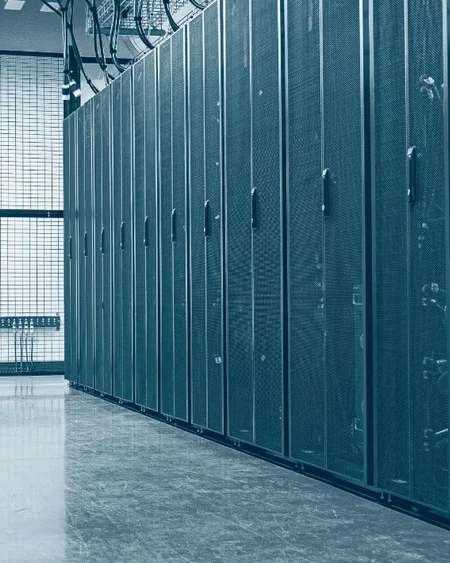
Two rooms do not necessarily mean two independent environments. Shared power, central network components or a single storage system can affect both. Start with the failure you need to handle and trace its effects through to the application.
Two rooms. One shared power supply.
The rooms and power supplies are separate, but the supply in this example is still not independent. Actual protection depends on the complete power chain, not the number of connections.
Define the protection objective
A faulty power supply, failed distribution board and inaccessible building are different scenarios. For each relevant scenario, check which components must continue running. Then decide whether a second supply, a separate fire compartment or another site is needed.
Make shared components visible
Two power supplies do not protect against every interruption. With the facilities team, trace both power paths back to their shared source. Apply the same principle to carriers and storage.
Duplicated, but still affected together
- Power: two supplies
Do both cables end at the same UPS or distribution board? Its total failure remains a shared failure scenario.
- WAN: two providers
Do both fibres use the same building entry or route? Separate contracts do not create physical separation.
- Storage: two paths
Do both lead to the same array? Multipathing protects against path failures, not the loss of the entire array.
DECISION POINTMark the first shared component on the plan. Then decide whether the separation covers the agreed failure scenario. Include DNS, identities and quorum.
Plan for the remaining capacity
After one side fails, the other must carry the intended applications. This includes CPU and RAM, storage performance and network bandwidth. Agree which lower-priority systems may pause during recovery operations. Also consider another component already being under maintenance.
Test failure scenarios in a controlled way
Derive an agreed test plan from the architecture. Define approvals, safeguards and stop criteria before disconnecting components or links. Test the return to normal operation as well as failover, including the business team's view.
Questions to resolve
- Which specific failure does physical separation cover?
- Which components and cable routes are shared?
- Which applications remain usable with the remaining capacity?
- Have failover and return to normal been tested?